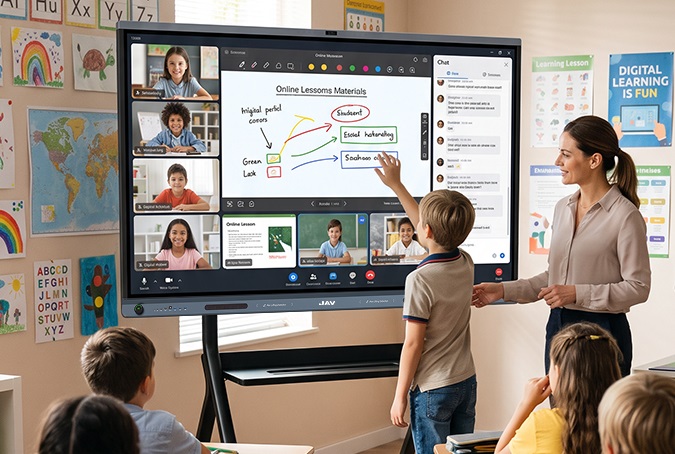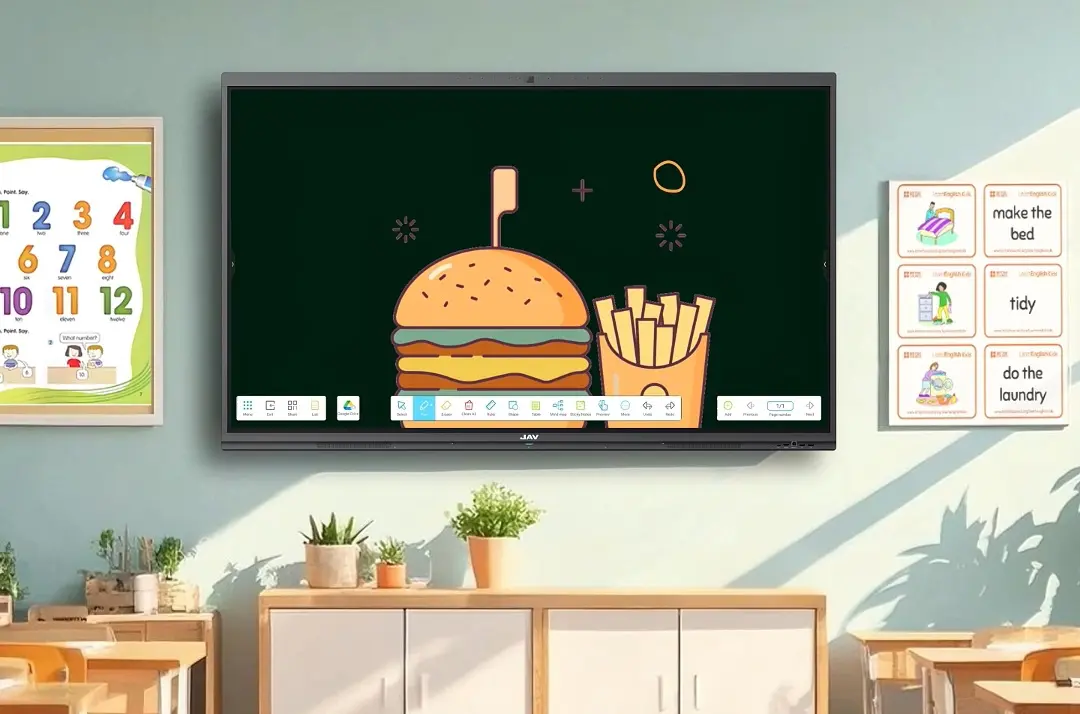
The shift toward student-centered classrooms has accelerated rapidly in recent years, and tools like the interactive display for education are playing a central role in that transformation. Among the latest solutions designed for modern learning environments, the JAV Board 10 interactive display stands out as a practical example of how hardware and software can come together to support more engaging, collaborative, and effective teaching.
Unlike traditional whiteboards or passive projection systems, the JAV Board 10 is built as an all-in-one interactive display for education environments, enabling teachers and students to interact directly with content in real time. As a modern interactive whiteboard for classroom environments, it combines digital whiteboarding, multimedia presentation, wireless collaboration, and annotation tools into a single platform. This shift fundamentally changes how lessons are delivered and how students participate in the learning process.
Why Active Learning Matters
Education has gradually shifted from teacher-centered instruction to student-centered learning. Instead of simply receiving information, students are encouraged to ask questions, solve problems, collaborate with classmates, and apply what they have learned.
Research has consistently shown that active learning improves educational outcomes. A widely cited study published in the Proceedings of the National Academy of Sciences found that students in active learning environments achieved higher exam scores and were significantly less likely to fail than those taught through traditional lectures. These findings explain why many schools are investing in technologies such as interactive displays for education to create more engaging classrooms.
By supporting discussion, collaboration, and real-time interaction, an interactive whiteboard for classroom helps teachers implement active learning strategies more effectively across different subjects and grade levels.
From Passive Listening to Active Participation
One of the most impactful benefits of an interactive display for education is its ability to turn passive lessons into active learning experiences. Instead of simply watching a teacher write on a board or present slides, students can directly engage with the material.
Feature
With the JAV Board 10, teachers can invite students to annotate diagrams, solve math problems step-by-step on the screen, or manipulate visual elements in science simulations.
Classroom Activity
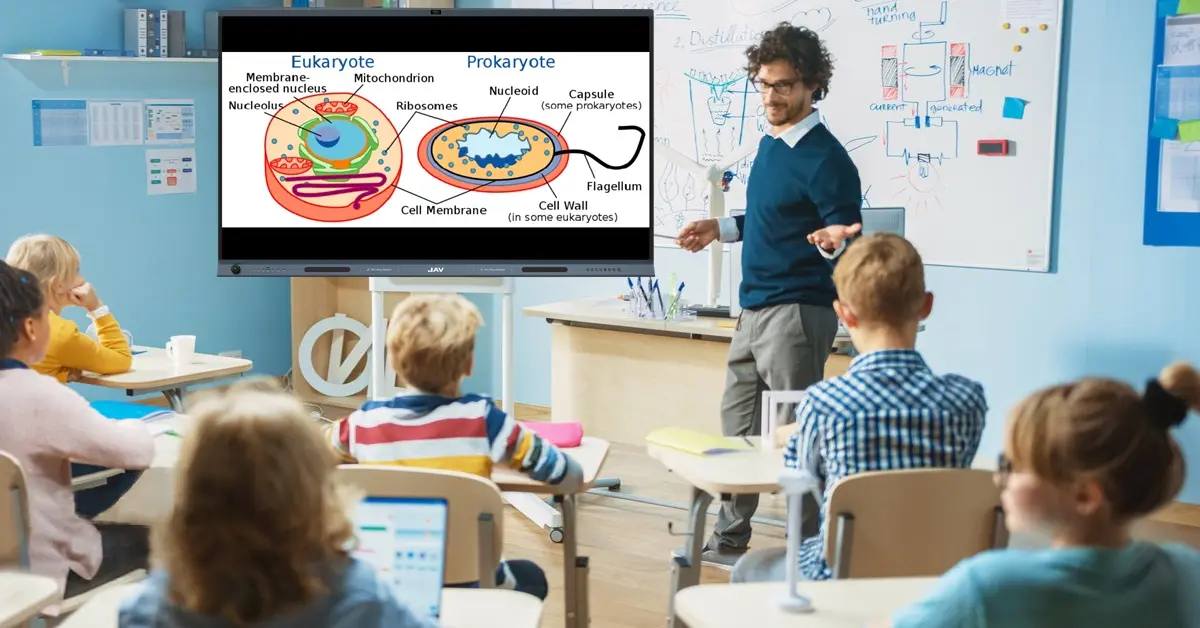
For example, during a Grade 6 mathematics lesson, students can come to the display one by one to solve different steps of an equation while classmates discuss alternative approaches. In a biology lesson, students can label the parts of a plant cell directly on the screen before comparing their answers as a class.
Learning Outcome
These hands-on activities encourage participation, strengthen conceptual understanding, and help students retain knowledge more effectively because they are actively involved in the learning process rather than simply observing it.
Supporting Collaborative Learning in Real Time
Collaboration is another core pillar of active learning strategies, and the interactive display for education makes it significantly easier to implement structured group work in both small and large classrooms.
Feature
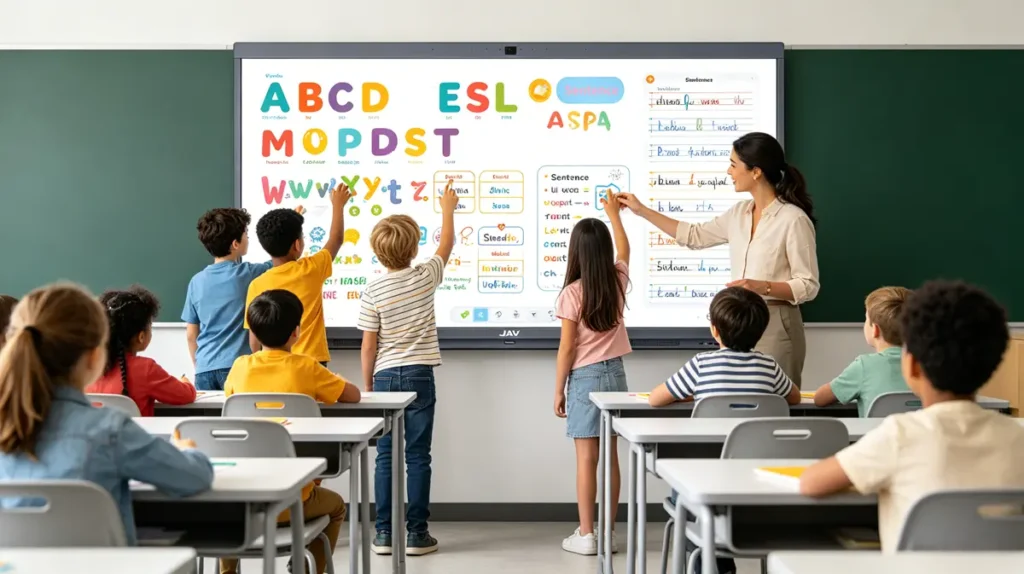
The JAV Board 10 supports multi-user interaction, allowing multiple students to contribute ideas on the screen simultaneously. Teachers can split the display into sections for group tasks or use brainstorming tools to collect ideas visually.
Classroom Activity
In a history class, different student groups can build timelines for historical events on separate sections of the screen before presenting their findings. During a language lesson, groups can organize vocabulary, images, and sentence structures together using the digital whiteboard.
In addition, the interactive whiteboard for classroom supports wireless screen sharing from student devices, allowing presentations and collaborative discussions to flow naturally.
Learning Outcome
Students develop communication, teamwork, and critical thinking skills while teachers spend less time managing classroom transitions and more time facilitating meaningful discussions.
Enhancing Visual and Multimedia Learning
Modern learners are highly responsive to visual and interactive content. The interactive display for education leverages this by integrating high-resolution visuals, videos, and interactive applications into everyday teaching.
Feature
The JAV Board 10 enhances this experience with its large 4K display and responsive touch system, allowing educators to present complex concepts with clarity.
Classroom Activity
For example, in a physics lesson, teachers can pause a simulation to annotate force vectors directly on the screen. In geography, students can zoom into satellite maps, identify landforms, and mark important locations collaboratively.
Learning Outcome
Interactive visualization makes abstract concepts easier to understand, helping students build stronger conceptual connections while maintaining higher levels of attention throughout the lesson.
Enabling Flexible Teaching Strategies
Active learning is not a single method—it is a framework that includes flipped classrooms, peer instruction, inquiry-based learning, and problem-based learning. The interactive display for education supports all of these strategies by acting as a central hub for instruction and interaction.
Feature
With the JAV Board 10, teachers can switch easily between presentation mode, whiteboarding, multimedia content, and collaborative annotation without interrupting lesson flow.
Classroom Activity
In a flipped classroom, students review learning materials before class, while classroom time focuses on discussion and problem-solving using the interactive display. During peer instruction, students present their own solutions on the screen and receive feedback from both classmates and teachers.
Learning Outcome
Teachers gain greater instructional flexibility, while students become more confident learners who actively participate in discussions, explain their thinking, and learn from one another.
Conclusion
As education continues to evolve, the role of technology becomes increasingly important in shaping how students learn and interact. The interactive display for education is no longer just a replacement for traditional boards—it is a foundation for active, collaborative, and student-centered learning environments.
The JAV Board 10 demonstrates how these capabilities can be implemented in a practical and impactful way, supporting teachers in delivering more dynamic lessons and helping students become active participants in their own learning journey.
In this new model of education, engagement is no longer optional—it is built into the classroom itself.
Frequently Asked Questions
What is an interactive display for education?
An interactive display for education is a large touchscreen device that combines a digital whiteboard, presentation system, computer, and collaboration platform into one solution. Teachers and students can write, annotate, present multimedia content, and interact with learning materials in real time.
How is an interactive display different from an interactive whiteboard for classroom use?
A traditional interactive whiteboard often requires a projector and external computer. In contrast, a modern interactive whiteboard for classroom—such as the JAV Board 10—is an all-in-one solution with a built-in operating system, touch display, annotation tools, and wireless screen sharing, making classroom setup simpler and more reliable.
How do interactive displays support active learning?
Interactive displays encourage students to participate directly in classroom activities through annotation, collaborative problem-solving, multimedia interaction, and group discussions. These features help transform passive instruction into active learning experiences.
Which subjects benefit most from an interactive display for education?
Interactive displays can enhance learning across nearly all subjects, including mathematics, science, language arts, history, geography, and STEM education, by making lessons more visual, interactive, and collaborative.