Modern workplaces rely heavily on efficient communication and collaboration tools, and the meeting room has become a critical hub for hybrid work. As companies upgrade their office infrastructure, one key decision often arises: should they adopt an all-in-one meeting room display system, or continue building a modular AV setup with separate components?
Both approaches have their advantages, but they differ significantly in deployment complexity, cost structure, usability, and long-term scalability. Using solutions like the JAV Board 10, which represents the all-in-one interactive display category, helps clarify how these two models perform in real business environments.
Understanding the Two Approaches
Before comparing them, it is important to define what each system includes.
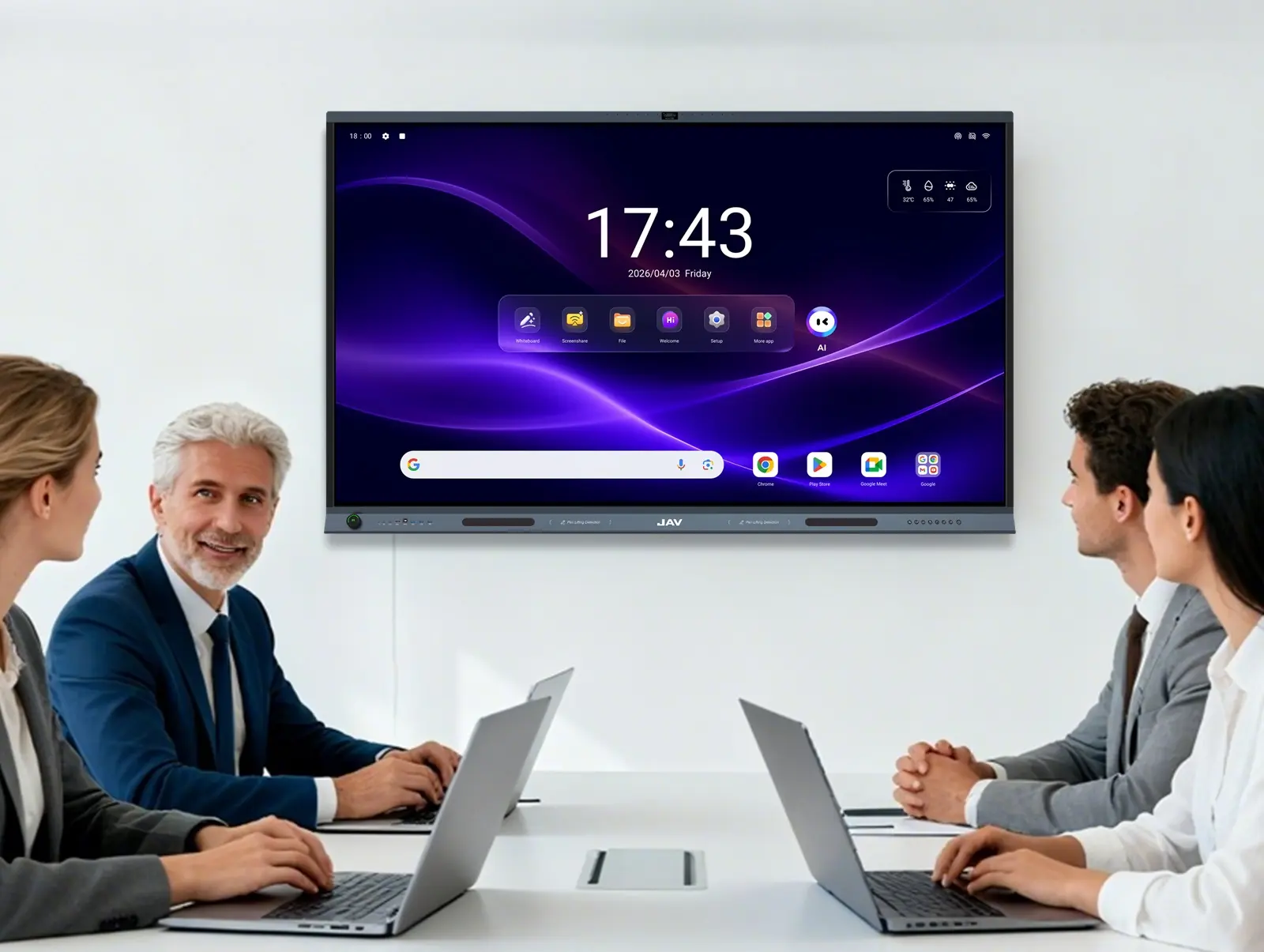
An all-in-one meeting room display system integrates multiple functions into a single device. Typically, it combines:
- A large interactive 4K display
- Built-in computing system (Android or Windows OPS support)
- Wireless screen sharing
- Whiteboarding and annotation tools
- Camera and audio integration (in advanced models)
The JAV Board 10 is an example of this approach. It is designed to function as a centralized collaboration hub, reducing the need for external devices while supporting real-time interaction.
In contrast, a modular AV system is built from separate components:
- Commercial display or projector
- External video conferencing camera
- Ceiling or table microphones
- Speakers or soundbars
- Dedicated conferencing PC or codec (Zoom Rooms / Microsoft Teams Rooms)
Each part is selected individually and integrated through configuration and cabling.
Deployment and Installation Complexity
One of the most immediate differences between the two systems is installation.
Modular AV systems require careful planning, professional installation, and ongoing maintenance. Each component must be compatible, configured correctly, and physically connected. This increases deployment time and introduces potential points of failure.
By contrast, the JAV Board 10 all-in-one meeting room display system significantly reduces setup complexity. Since core hardware and software are integrated into a single unit, businesses can deploy it with minimal infrastructure changes. For IT teams, this means fewer compatibility issues, less wiring, and faster rollout across multiple meeting rooms.
User Experience and Ease of Use
User experience is often where all-in-one systems demonstrate a clear advantage.
In modular setups, users frequently switch between inputs, manage multiple remotes or control panels, and troubleshoot connection issues—especially in hybrid meetings involving external devices.
The JAV Board 10 simplifies this workflow by centralizing interaction on a single interactive display. Users can:
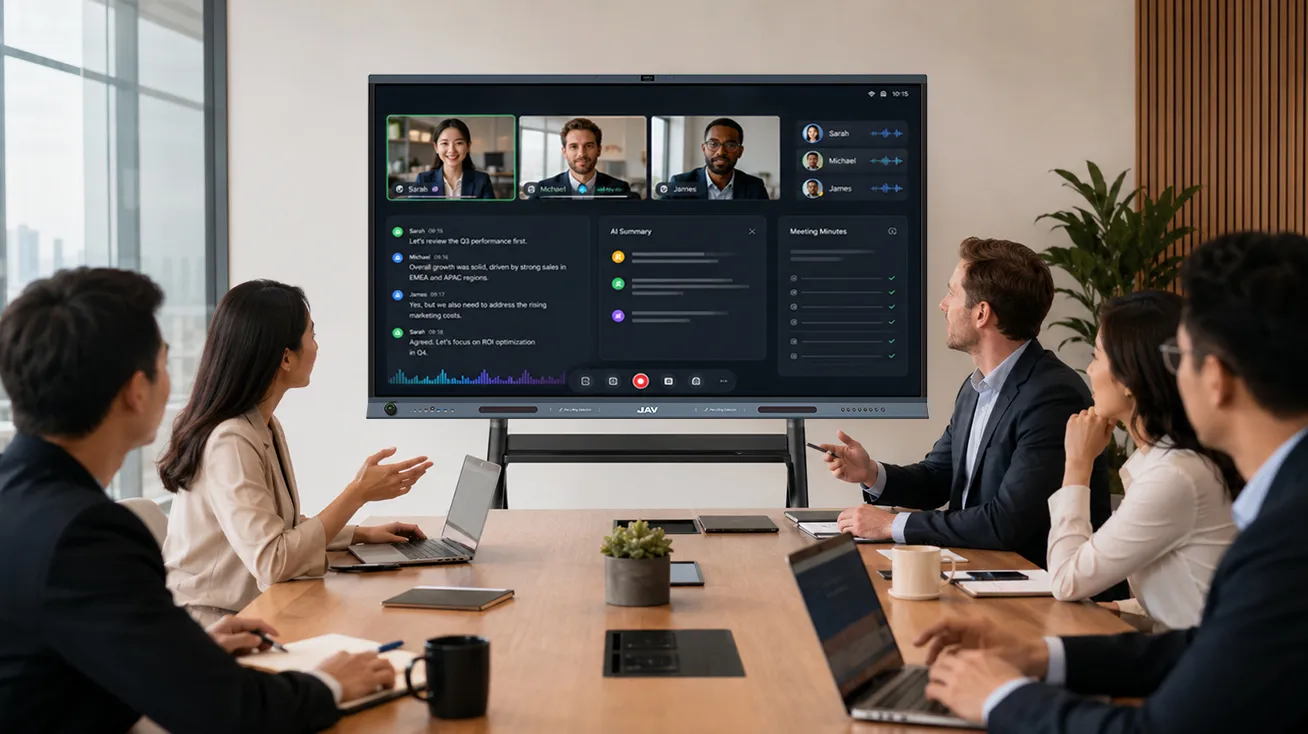
- Start meetings directly from the display
- Annotate content in real time
- Share screens wirelessly from laptops or mobile devices
- Collaborate on digital whiteboards without switching systems
This unified experience reduces friction and allows meetings to start faster, which is critical in fast-paced business environments.
Flexibility and Customization
Where modular AV systems excel is flexibility. Businesses can select high-end cameras, premium microphones, or specialized conferencing software based on specific requirements. This makes modular setups attractive for large enterprises with complex audiovisual needs.
However, this flexibility comes at the cost of integration complexity.
The all-in-one approach, such as the JAV Board 10, prioritizes streamlined functionality over component-level customization. While it may not match the absolute peak performance of specialized standalone devices in every category, it delivers balanced performance across display, collaboration, and communication functions—sufficient for most meeting room scenarios such as huddle rooms, training rooms, and boardrooms.
Cost Efficiency and Long-Term Maintenance
From a cost perspective, modular AV systems often have higher upfront and long-term costs due to:
- Multiple hardware purchases
- Professional installation fees
- Ongoing maintenance across different vendors
- Upgrade complexity when replacing individual components
The JAV Board 10 meeting room display system reduces these costs by consolidating hardware into one platform. Maintenance is simplified because IT teams deal with a single device rather than an interconnected ecosystem. Software updates are also centralized, reducing operational overhead.
Over time, this can lead to lower total cost of ownership (TCO), especially for organizations scaling across multiple rooms.
Scalability Across Organizations
For growing companies, scalability is a key factor.
Modular systems can scale, but each new room requires repeated integration work and configuration.
All-in-one systems like the JAV Board 10 scale more efficiently. Businesses can deploy identical units across multiple rooms, ensuring consistency in user experience and reducing training needs. This standardization is particularly valuable for enterprises with distributed teams or multi-location offices.
Conclusion: Which Is Better?
There is no universal answer, but the decision depends on business priorities.
- If an organization requires maximum customization, high-end audiovisual engineering, and complex conferencing environments, a modular AV system may still be appropriate.
- If the goal is simplicity, fast deployment, lower maintenance, and consistent user experience, an all-in-one meeting room display system is often the better choice.
The JAV Board 10 illustrates how modern all-in-one solutions are reshaping meeting room design. By combining interactive display technology, collaboration tools, and integrated system architecture, it offers a streamlined alternative to traditional AV complexity—particularly suited for today’s hybrid, fast-moving work environments.