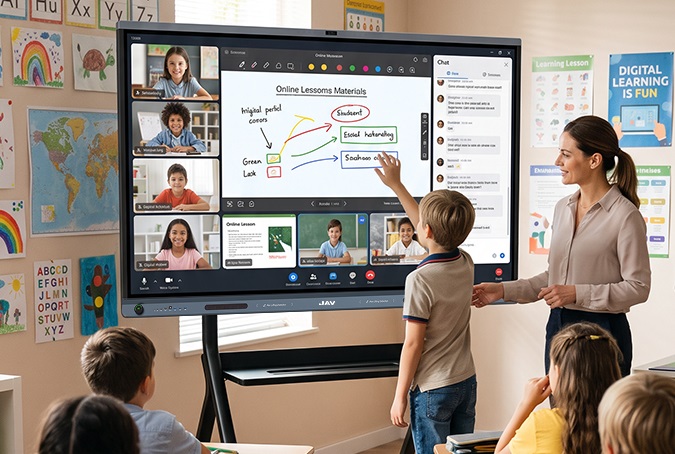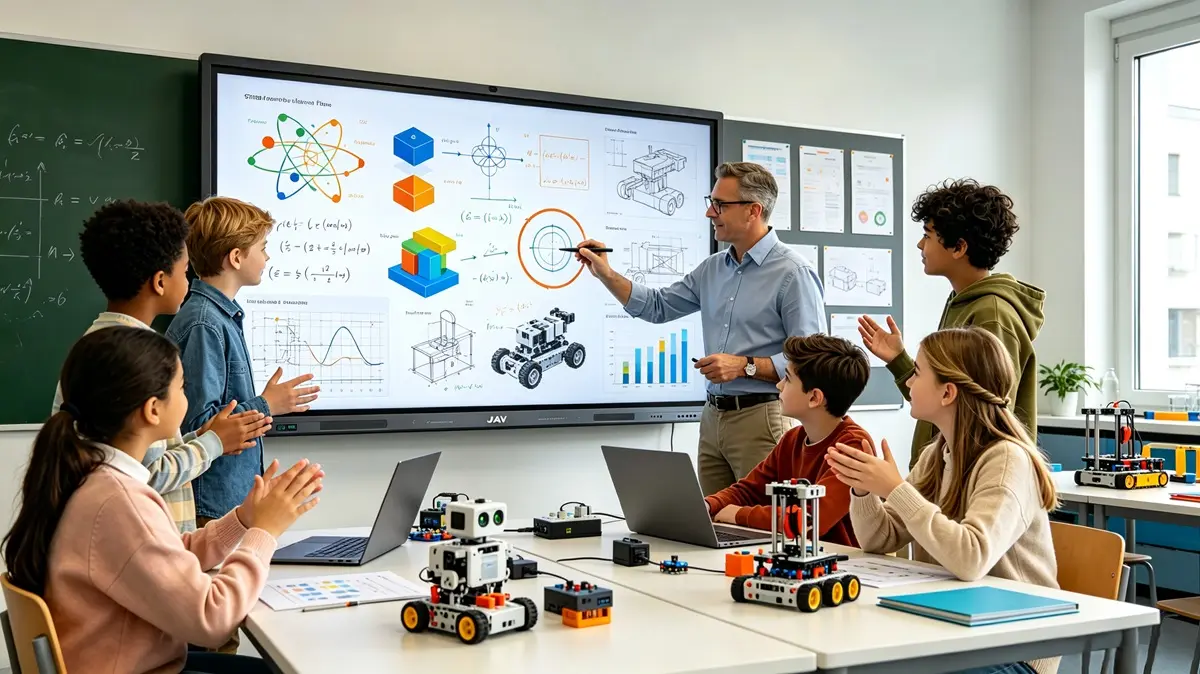
STEM education focuses on developing students’ skills in science, technology, engineering, and mathematics through exploration, problem-solving, and hands-on activities. However, teaching STEM subjects effectively often requires more than textbooks and traditional teaching tools. Complex concepts such as scientific processes, mathematical models, engineering designs, and coding logic are easier for students to understand when they can visualize, interact with, and experiment with digital content.
An interactive display for education provides a powerful solution by transforming classrooms into collaborative learning environments. With touch interaction, multimedia support, and real-time collaboration features, interactive displays help teachers deliver more engaging STEM lessons. The Écran interactif JAV Board 10 is designed to support these learning scenarios, enabling educators to bring STEM concepts to life through interactive teaching experiences.
Why Modern STEM Education Requires Interactive Learning
Modern STEM education is no longer focused solely on memorizing scientific facts or mathematical formulas. Today’s classrooms emphasize inquiry-based learning, project-based learning, collaboration, and critical thinking—skills that prepare students for future careers in science, engineering, and technology.
To support these learning models, students need opportunities to explore concepts, test ideas, analyze results, and work together to solve real-world problems. Traditional teaching methods that rely primarily on lectures or static presentations often make it difficult for students to develop these practical skills.
Research also supports this shift. A landmark meta-analysis published in the Proceedings of the National Academy of Sciences (PNAS) found that students enrolled in active-learning STEM courses achieved higher examination scores and experienced significantly lower failure rates than students taught through traditional lecture-based instruction. These findings have encouraged schools worldwide to invest in technologies such as interactive displays for education, and other digital learning tools that make active participation easier to achieve.
Rather than simply delivering information, these technologies help create interactive STEM classrooms where students learn through observation, discussion, experimentation, and collaboration.
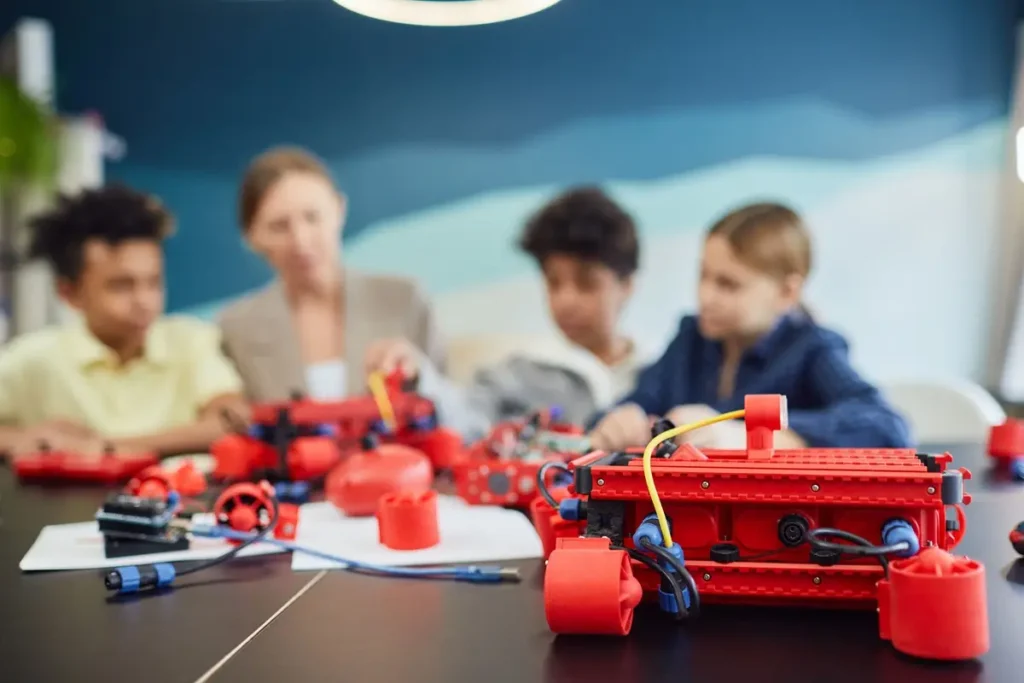
Why STEM Classrooms Need Interactive Displays
STEM subjects often involve abstract concepts that are difficult to explain through static materials alone. For example, students may struggle to understand complex scientific structures, visualize mathematical relationships, or connect theoretical knowledge with real-world applications.
Traditional teaching methods usually rely on printed diagrams, textbooks, or projector-based presentations. While these tools can deliver information, they provide limited opportunities for students to interact directly with learning materials.
An interactive display for education changes this approach by allowing students to participate actively. Instead of simply watching a demonstration, students can manipulate digital models, annotate diagrams, solve problems directly on the screen, and collaborate with classmates.
This interactive learning approach supports deeper understanding and encourages curiosity, creativity, and critical thinking—key skills at the heart of STEM education.
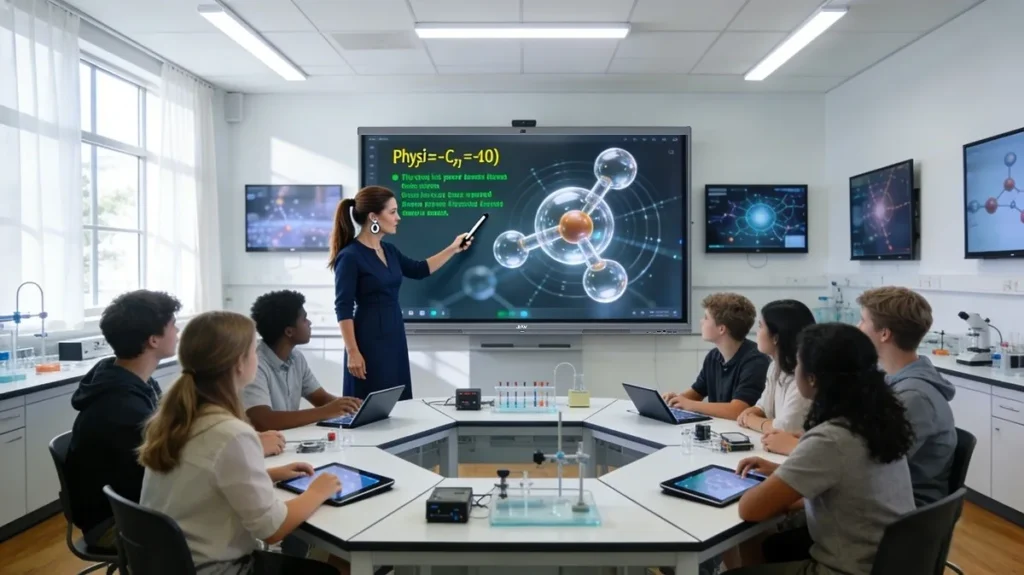
Real STEM Use Cases with Interactive Displays
1. Making Science Lessons More Visual and Interactive
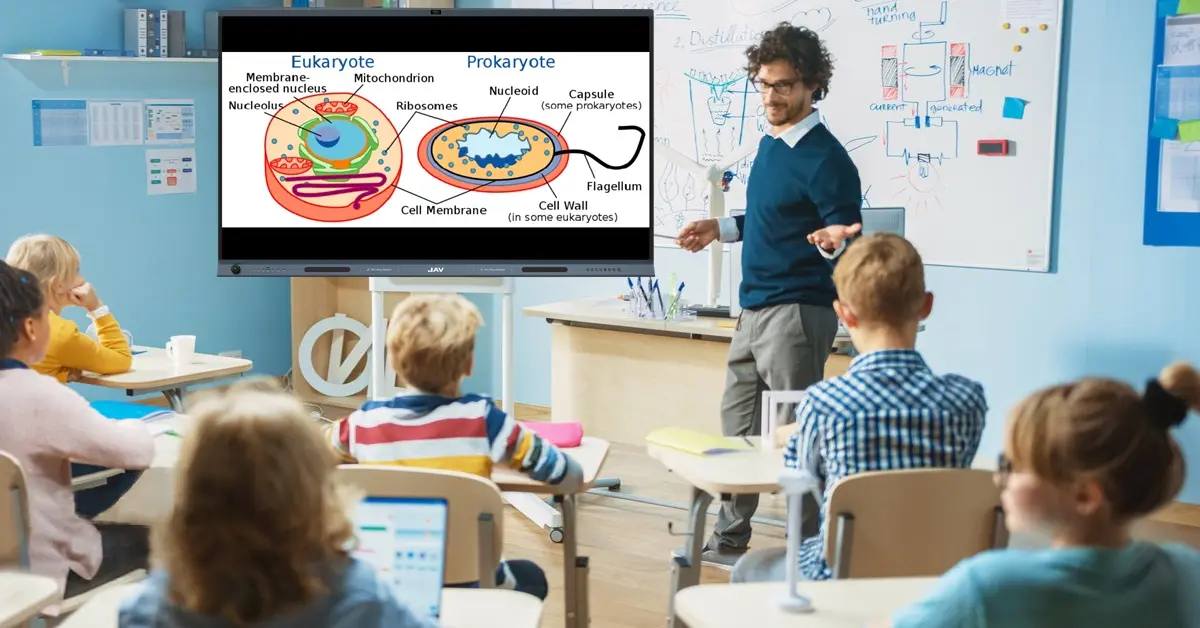
Science concepts often involve processes that cannot be easily observed in a traditional classroom. Topics such as cell structures, chemical reactions, ecosystems, and physics experiments require visualization to help students build stronger connections.
With the JAV Board 10, teachers can display high-resolution scientific images, videos, simulations, and interactive models on a 4K UHD screen. Students can zoom into details, highlight important elements, and participate in discussions directly on the display.
For example, in a biology lesson, teachers can show a detailed plant cell model and ask students to label different components using touch annotation. In physics classes, students can analyze motion simulations and mark key observations directly on the screen.
By turning abstract information into interactive experiences, STEM lessons become easier to understand and remember.
2. Supporting Hands-On Math Learning
Mathematics is often viewed as a subject based on formulas and calculations, but interactive teaching methods can help students understand the logic behind mathematical concepts.
An interactive display for education allows teachers to demonstrate equations step by step, visualize geometric shapes, and create interactive problem-solving activities.
For example, teachers can use the JAV Board 10 to draw graphs, adjust variables in real time, and demonstrate how changes affect mathematical outcomes. Students can also solve problems directly on the display, allowing teachers to provide immediate feedback.
This approach helps move math education from memorizing formulas to understanding concepts through exploration.
3. Encouraging Engineering Design and Collaboration
Engineering education emphasizes creativity, teamwork, and problem-solving. Students need opportunities to design solutions, test ideas, and refine their approaches.
Interactive displays can serve as collaborative digital workspaces where students brainstorm ideas and develop projects together.
In an engineering activity, students can use the JAV Board 10 to sketch a bridge design, annotate structural elements, and discuss improvements as a group. Teachers can save these ideas, compare different solutions, and guide students through the design process.
This collaborative workflow mirrors real engineering environments, helping students develop practical skills beyond theoretical knowledge.
4. Enhancing Coding and Technology Education
Technology education requires students to understand logical thinking and digital systems. Interactive displays provide a flexible platform for teaching programming concepts, algorithms, and digital skills.
Teachers can display code examples, explain programming structures, and encourage students to analyze problems together. Students can annotate code, organize ideas through digital brainstorming, and present their solutions to the class.
With wireless content sharing capabilities, students can also present their projects from personal devices, creating a more connected and interactive technology classroom.
Lesson Ideas Using JAV Board 10
Here are several STEM lesson activities that can be enhanced with an interactive display:
Science: Virtual Experiment Analysis
Students watch a simulation of an experiment, identify key observations, and annotate results directly on the screen.
Mathematics: Interactive Problem Solving
Students work in groups to solve equations or geometry challenges using the digital whiteboarding function.
Engineering: Design Thinking Workshop
Students create and present engineering concepts using collaborative digital sketches.
Technology: Coding Explanation Sessions
Teachers and students review programming logic together through screen sharing and real-time annotation.
These activities encourage students to become active participants rather than passive listeners.
The Future of STEM Learning with Interactive Displays
As schools continue to adopt digital learning strategies, the role of classroom technology is evolving. An interactive display for education is no longer just a replacement for a traditional whiteboard—it has become a central platform for collaboration, visualization, and creative learning.
The JAV Board 10 interactive display supports this transformation by combining high-quality visual presentation, interactive writing, wireless collaboration, and communication features into one integrated solution. For STEM classrooms, this means teachers can create more engaging lessons while giving students more opportunities to explore, collaborate, and solve real-world problems.
By bringing digital interaction into everyday teaching, interactive displays are helping build classrooms that prepare students for the challenges of the future.