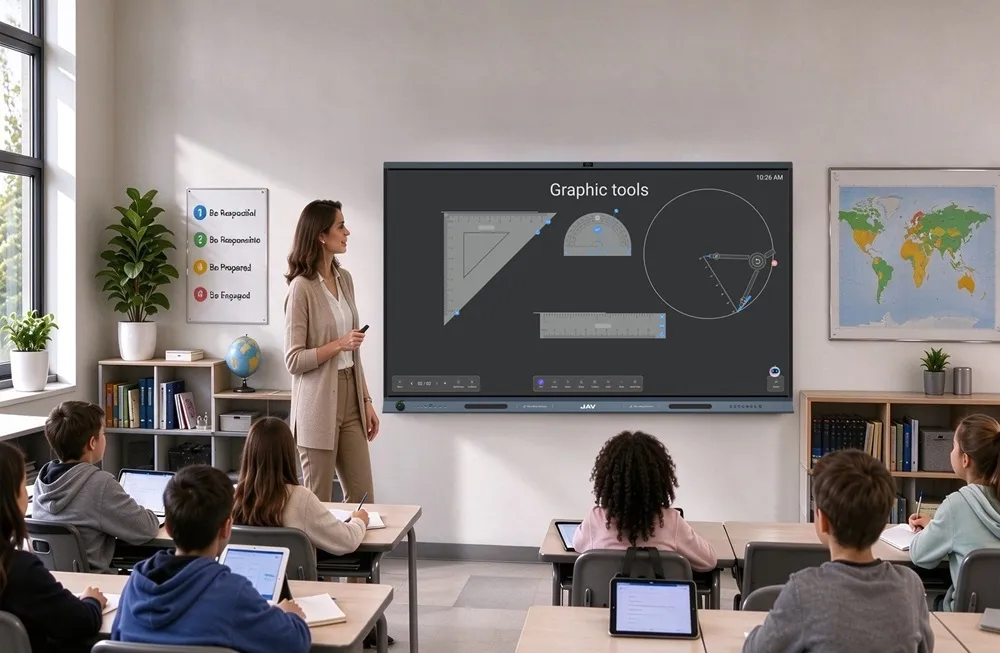
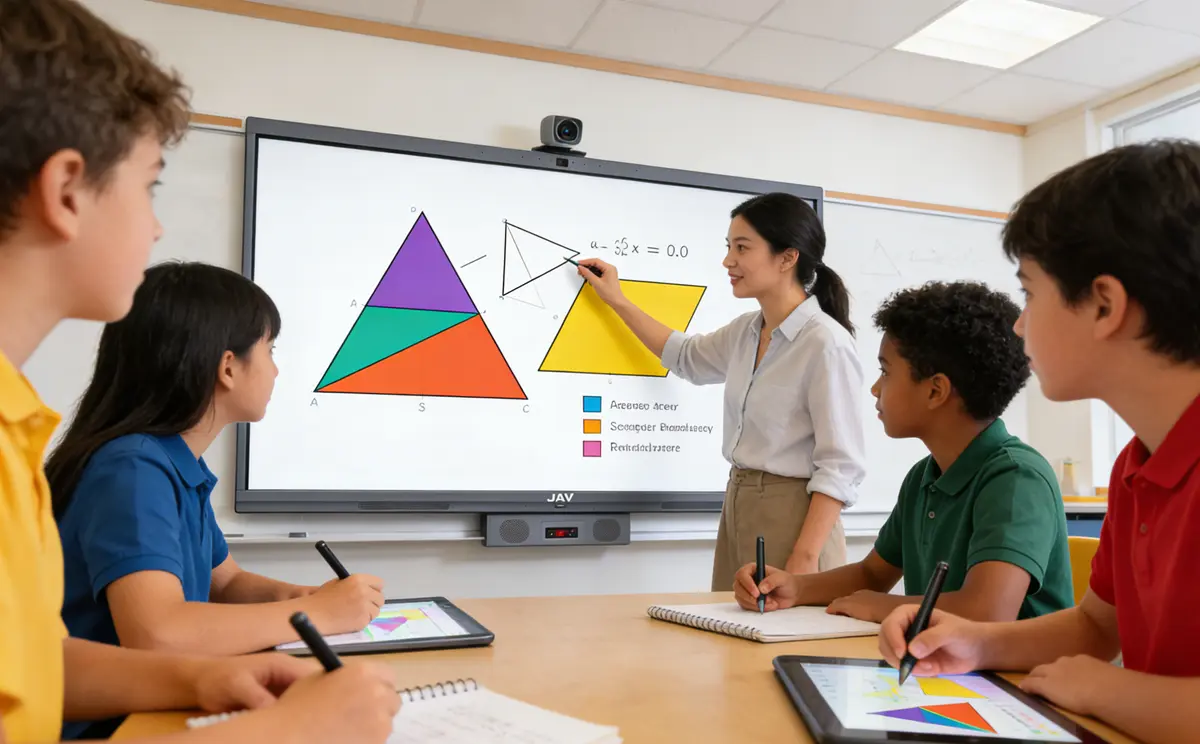
In Grade 6 mathematics, ratios and rates represent a foundational shift from arithmetic to proportional reasoning. However, many classrooms still rely on traditional teaching tools—such as static whiteboards and textbooks—that make it difficult for students to visualize proportional relationships and apply them to real-world problems. To address this gap, many schools are turning to interactive whiteboards, a new generation of digital teaching tools that combine a large touch display, built-in whiteboard software, and classroom collaboration features.
Unlike conventional boards, an interactive whiteboard allows teachers and students to manipulate numbers, diagrams, and data in real time, making abstract mathematical concepts more intuitive and engaging. Solutions like the JAV Board 10 help educators connect ratios and rates to authentic scenarios while improving student participation and conceptual understanding.
Why Ratios and Rates Are Challenging in Grade 6 Math Classrooms
Ratios and rates are central topics in the Common Core Grade 6 curriculum, yet many students struggle with:
- Distinguishing between ratios and unit rates
- Visualizing proportional relationships
- Applying ratios to real-world scenarios
Without visual and interactive representations, these concepts often remain abstract symbols on paper. This gap can hinder students’ readiness for algebra and higher-level math reasoning.
What Is an Interactive Whiteboard as a Modern Math Teaching Tool
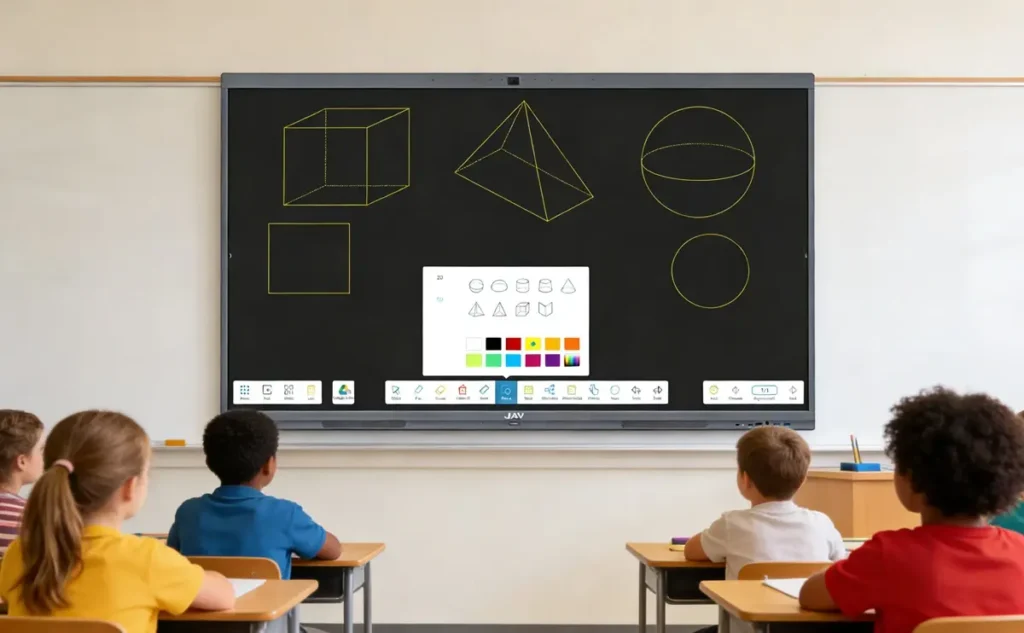
One of the most effective uses of an interactive whiteboard is the ability to create dynamic visual models. On the Tableau blanc interactif JAV Board 10, teachers can use the built-in whiteboard app to draw ratio tables, double number lines, and tape diagrams.
For example, a teacher can demonstrate a ratio of 3:5 using color-coded bars, then dynamically scale the ratio to 6:10 or 9:15. Students can physically manipulate the models on the screen, reinforcing the concept of equivalent ratios.
This interactive visualization allows students to see how proportional relationships scale, rather than simply memorizing procedures.
Use an Interactive Whiteboard to Connect Ratios to Real-World Applications
Ratios and rates become meaningful when students see them applied to authentic problems. With Google EDLA certification, the JAV Board 10 allows teachers to open Google Slides, Sheets, and web-based simulations directly on the board without an external PC.
Teachers can present real-world scenarios such as:
- Cost per item comparisons in shopping contexts
- Speed and distance calculations
- Recipe scaling for cooking activities
By embedding videos, datasets, and interactive simulations, students can analyze real data and discuss proportional relationships collaboratively. This approach transforms ratios from abstract numbers into practical problem-solving tools.
Collaborative Learning with an Interactive Whiteboard in Grade 6 Math
Interactive whiteboards also support multi-touch input, allowing multiple students to work on the same problem simultaneously. During group activities, students can annotate steps, highlight errors, and present their reasoning directly on the screen.
For instance, a group might solve a unit rate problem while another group critiques their approach in real time. Teachers can use annotation tools to guide discussions and emphasize key mathematical reasoning strategies.
This collaborative environment encourages mathematical discourse, which research shows is critical for developing conceptual understanding.
Integrating Digital Teaching Tools for Differentiated Instruction
Modern classrooms require differentiated instruction to meet diverse learning needs. The JAV Board 10 integrates seamlessly with digital teaching tools such as interactive worksheets, learning apps, and assessment platforms.
Teachers can display adaptive practice exercises, collect student responses through connected devices, and adjust instruction based on real-time feedback. This capability ensures that students who struggle with proportional reasoning receive targeted support, while advanced learners explore more complex applications.
Building Mathematical Reasoning Through Step-by-Step Annotation
Beyond visualization, interactive whiteboards support structured reasoning through step-by-step annotation. Teachers can model problem-solving processes, highlight proportional reasoning strategies, and annotate misconceptions as they arise.
For example, when solving a ratio word problem, the teacher can:
- Highlight key information
- Set up the ratio or rate equation
- Demonstrate cross-multiplication or unit rate conversion
- Verify the solution
This transparent problem-solving process helps students internalize mathematical thinking patterns.
Building Algebra Readiness Through Interactive Whiteboard-Based Ratio Instruction
Ratios and rates form the foundation of linear relationships and algebraic functions. By using an interactive whiteboard to connect proportional tables, graphs, and equations, teachers can introduce algebraic concepts in a visual and intuitive way.
Students can explore how a constant ratio leads to a straight-line graph, bridging Grade 6 mathematics with future algebra coursework.
Why Interactive Whiteboards Are Core Infrastructure for Modern Math Classrooms
Interactive whiteboards are no longer optional classroom accessories—they are core instructional infrastructure. As comprehensive teaching tools, they support visualization, collaboration, differentiation, and digital integration in a single platform.
For schools and districts evaluating classroom technology investments, solutions like the JAV Board 10 provide a scalable and future-ready platform for mathematics instruction. By enhancing conceptual understanding and student engagement, interactive displays directly contribute to improved learning outcomes.
Conclusion
Teaching ratios and rates effectively requires more than formulas and worksheets. It requires visualization, interaction, and contextual learning. An interactive whiteboard empowers educators to transform abstract proportional reasoning into concrete, collaborative learning experiences.
With integrated digital tools, real-time annotation, and collaborative capabilities, platforms like the JAV Board 10 enable educators to deliver deeper conceptual instruction and prepare students for algebra and beyond.