In today’s evolving education landscape, STEM teaching tools are no longer optional—they are essential for building hands-on, inquiry-driven learning environments. As science, technology, engineering, and math lessons become more visual and collaborative, the interactive whiteboard has emerged as one of the most effective tools for modern classrooms. More than a display surface, it now functions as a central hub for instruction, experimentation, collaboration, and real-time problem solving.
1. Why STEM Teaching Tools Need to Evolve
One of the biggest challenges in STEM education is turning abstract concepts into visible, interactive learning experiences.
Teachers often need to explain:
- scientific processes
- mathematical models
- engineering diagrams
- data visualization
- coding logic
These subjects are inherently dynamic, but many classrooms still rely on static teaching methods.
This creates a major gap between concept explanation and student comprehension.
For example, explaining the structure of a molecule, the movement of forces in a physics problem, or a multi-step geometry proof on a static board often makes it difficult for students to fully engage.
This is why schools are actively seeking better STEM teaching tools that support visual learning and real-time interaction.
2. The Problem with Traditional STEM Teaching Tools
Traditional tools such as projectors, standard whiteboards, and printed worksheets still have value, but they present several limitations in STEM-focused classrooms.
Limited Interaction
A projector can display content, but it does not allow students to directly manipulate diagrams, move variables, or solve problems on-screen.
Fragmented Workflow
Teachers often need to switch between:
- laptop
- projector
- whiteboard
- physical teaching models
This interrupts lesson flow and reduces teaching efficiency.
Low Student Participation
In many traditional classroom setups, students remain passive viewers instead of active participants.
This is especially problematic in STEM subjects, where learning by doing significantly improves retention.
3. How Interactive Whiteboards Improve STEM Teaching Tools
This is where the interactive whiteboard becomes a high-value solution.
Modern interactive displays help transform passive instruction into collaborative problem-solving.
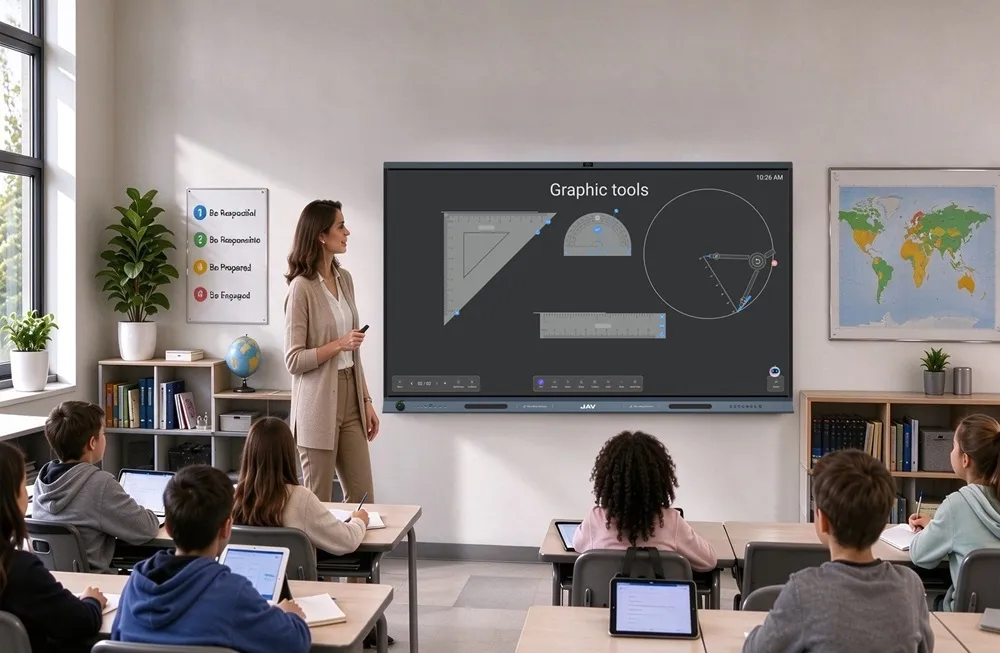
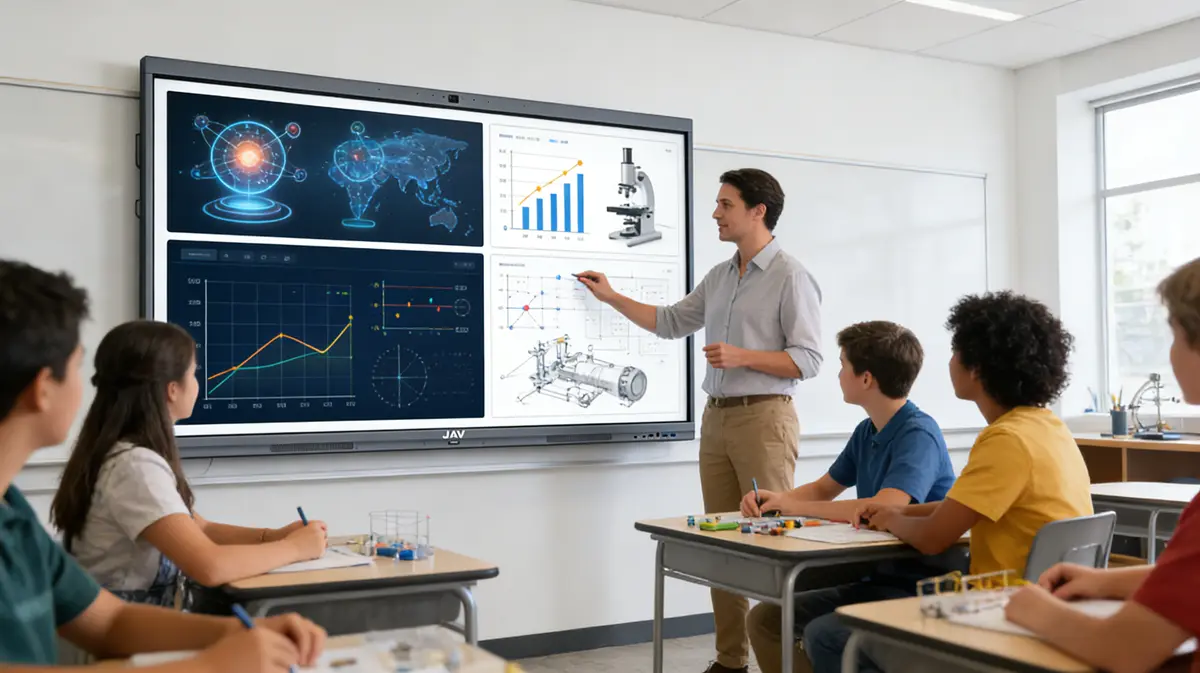
Visualizing Complex Concepts
Teachers can display and annotate:
- live equations
- 3D science diagrams
- graphs and simulations
- engineering models
For example, instead of drawing a graph step by step on a static board, teachers can instantly manipulate variables and show how curves change in real time.
By allowing students to interact with lessons, it deepens their understanding instead of simply presenting information.
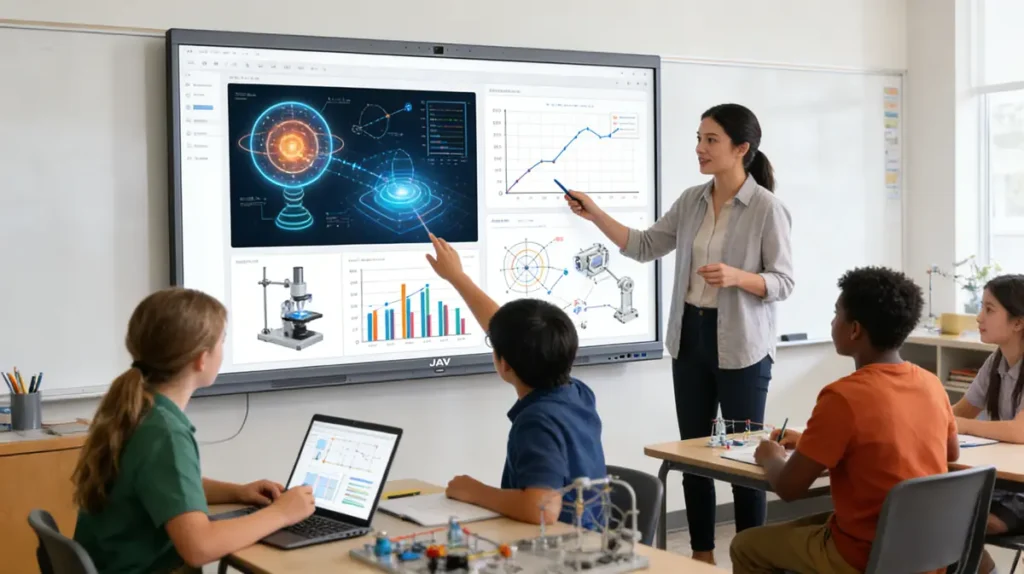
Real-Time Collaboration
Students can come to the board and:
- solve equations
- drag molecular structures
- complete coding flowcharts
- participate in group challenges
This active participation is one of the biggest advantages of advanced STEM teaching tools.
Multi-Device Integration
Many interactive displays support:
- ワイヤレスキャスト
- tablet sharing
- laptop connectivity
- cloud lesson storage
This reduces classroom friction and improves teaching continuity.
4. Real Classroom Application: A Mini Story
Imagine a middle school science teacher explaining the water cycle.
Instead of showing a static slide, the teacher uses an interactive whiteboard to display an animated diagram.
Students take turns dragging labels such as:
- evaporation
- condensation
- precipitation
Later in the same lesson, the teacher opens a temperature graph and asks students to predict how environmental changes affect evaporation speed.
Students come to the screen, move data points, and discuss the results.
This turns a standard lecture into an interactive STEM exploration.
The result is stronger participation, better memory retention, and more collaborative learning.
5. Bringing It All Together with JAV Board 10
For schools looking to upgrade their STEM teaching tools, solutions like JAVボード10 naturally align with the demands of modern classrooms.
As a professional interactive whiteboard, it is designed not only for visual teaching and touch collaboration, but also for the software flexibility that STEM instruction often requires.
Teachers can use it for:
- graphing mathematical functions
- displaying science simulations
- annotating engineering diagrams
- running coding demonstrations
- supporting collaborative group activities
What makes it especially valuable for STEM education is its Android operating system with Google EDLA certification.
This means teachers and schools can securely install virtually any Android-based educational app they need for instruction, including:
- STEM simulation tools
- coding and robotics apps
- virtual lab platforms
- math graphing software
- science visualization applications
- Google Classroom and Google Workspace apps
This level of app compatibility significantly expands how the board can be used in daily teaching.
For example, a physics teacher can run a motion simulation app directly on the screen, while a math teacher can use graphing software to visualize function changes in real time.
Instead of relying on multiple disconnected devices, JAV Board 10 combines hardware interaction with a flexible software ecosystem, making it one of the most practical STEM teaching tools for modern classrooms.
6. ROI and Efficiency Gains: A Smarter B2B Investment for Schools
For school administrators, IT teams, and procurement managers, the ROI of STEM teaching tools should be evaluated beyond the initial hardware cost.
The real value lies in the long-term operational and educational return.
With a traditional classroom setup, schools often need to invest in multiple separate tools, such as:
- projectors
- whiteboards
- external speakers
- teacher laptops
- software terminals
- maintenance and lamp replacements
This fragmented setup increases both capital expenditure and ongoing support costs.
By contrast, an interactive whiteboard such as JAV Board 10 consolidates multiple functions into a single platform.
This reduces the need for separate classroom devices and lowers the total cost of ownership over time.
From a B2B procurement perspective, the ROI can be measured across three key dimensions:
1. Lower Infrastructure and Maintenance Costs
Unlike projectors, there are no recurring lamp replacement costs, alignment issues, or image degradation over time.
The Android-based system with Google EDLA support also minimizes the need for dedicated external PCs in many classroom scenarios.
This can significantly reduce IT maintenance workload across multiple classrooms.
2. Higher Teaching Efficiency at Scale
For schools deploying across several classrooms or campuses, standardized interactive displays improve operational consistency.
Teachers can access the same apps, lesson materials, and collaboration tools across rooms, reducing setup time and improving workflow efficiency.
Even saving 5–10 minutes per lesson can create substantial instructional time gains over an academic year.
3. Improved Learning Outcomes and Utilization Rate
One of the most important but often overlooked ROI metrics is device utilization.
Traditional projectors are often used only for slide display.
In contrast, a professional STEM teaching tool like JAV Board 10 supports:
- lesson delivery
- student collaboration
- app-based simulations
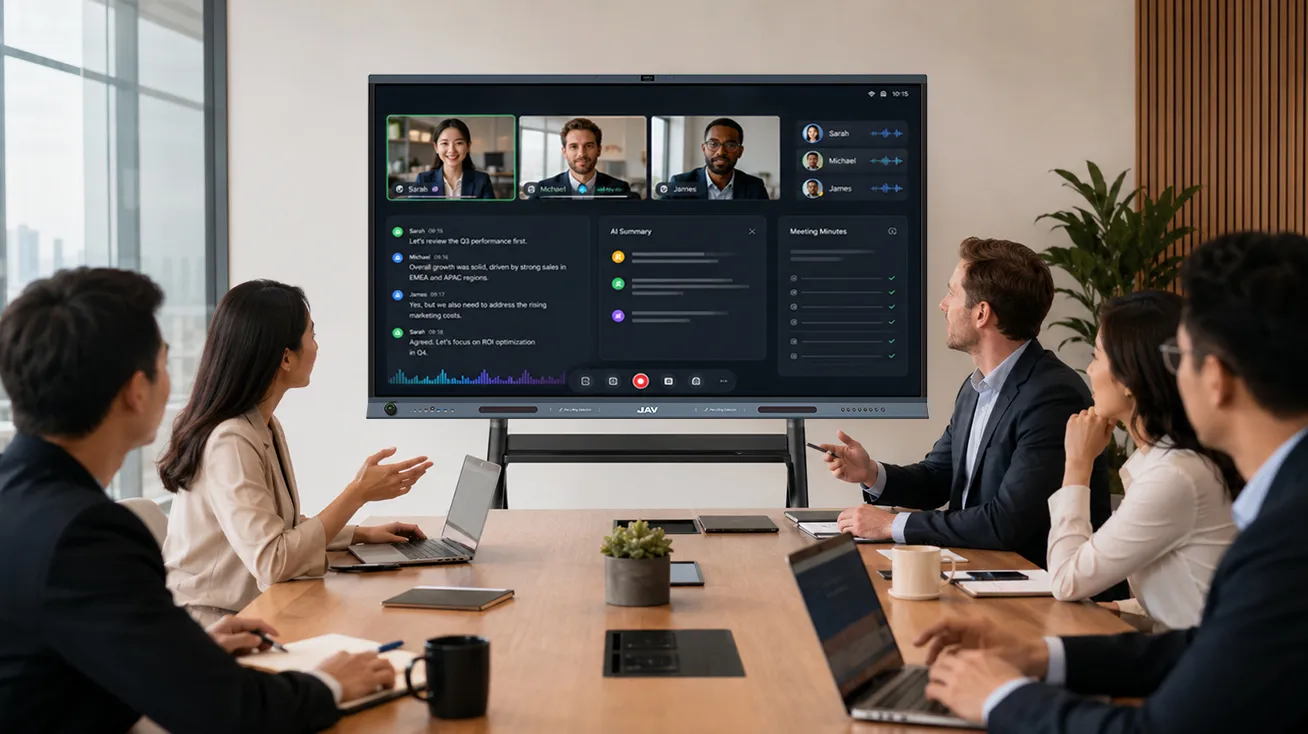
- hybrid learning
- assessments
- teacher training sessions
This higher utilization rate increases the value generated per classroom investment.
For B2B buyers, the decision is not simply about buying a screen—it is about investing in a scalable teaching infrastructure that improves both educational outcomes and long-term operational efficiency.
In this sense, an interactive whiteboard delivers stronger ROI than traditional classroom tools while positioning schools for future-ready STEM education.